
Budget feature overview
Budget feature overview
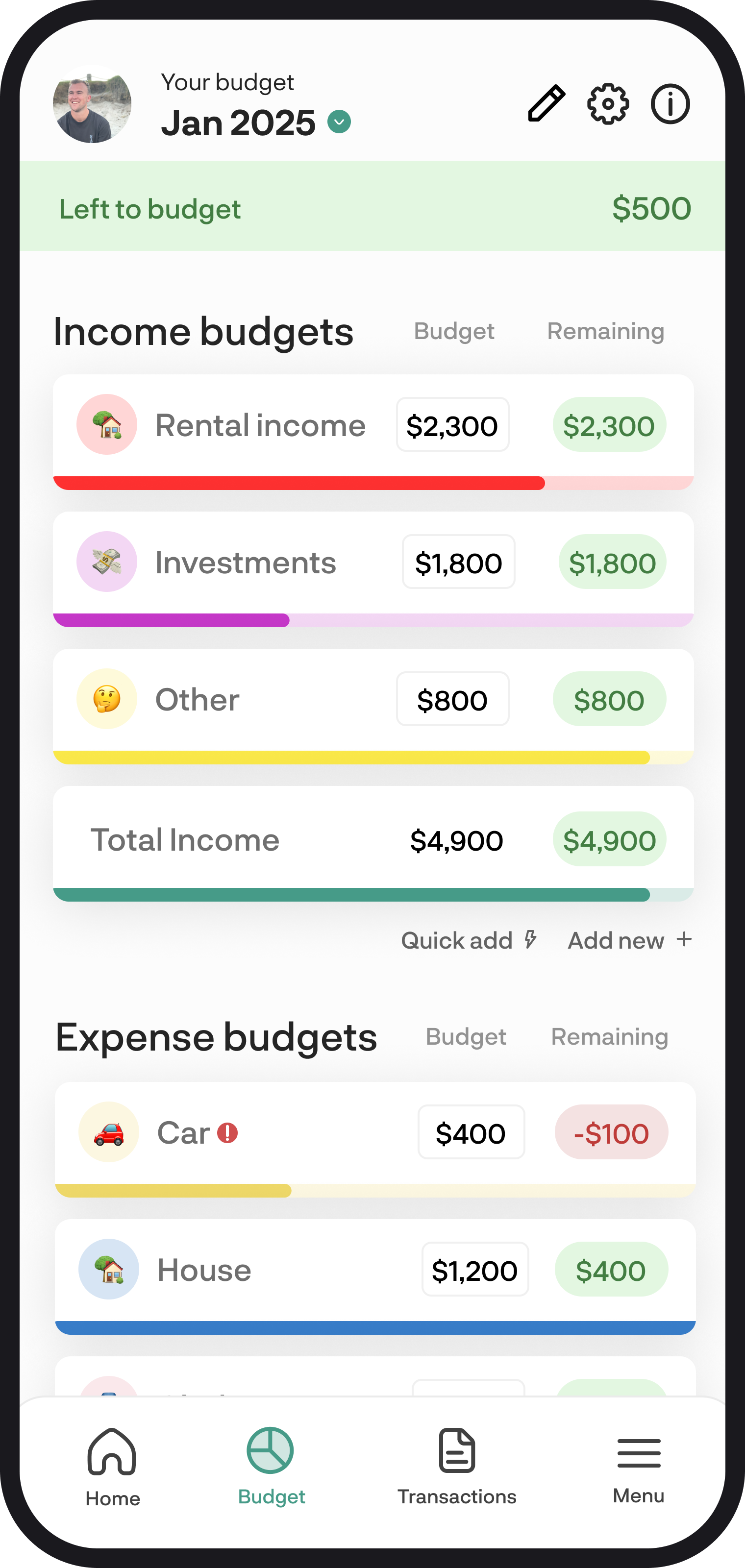
Setting a budget lets you keep track of your hard-earned pennies and brings a lot of other BudgetBuddie features to life. You can set weekly, fortnightly, monthly, or custom budgets for income and expenses, then track against them.
You can also group related budgets, mark an expense as savings, and set one-off budgets for spending that isn't part of your regular cycle.
1. A quick summary
Add income budgets under Income and expense budgets under Expenses. The period for all regular budgets is set once in Budget settings, not when you add a single budget.
You can switch between Classic and Compact views, look at past and future periods, and use the breakdown to see leftover money.
2. Adding an income or expense budget
On the Income or Expense list, you can add a budget in two ways:
- Quick add - shows a list of suggested categories with amounts filled from your real transactions. Edit any amount, then add the ones you want
- Add budget - opens the full setup so you can pick or create a category, set the amount, turn on rollover, and add a colour and emoji
If you've connected accounts, suggested amounts are often pre-filled from your usual spend. You can change them.
For the full steps, read How to create an income budget or How to create an expense budget.
3. Grouping budgets
Use a group when related budgets belong together, like Food with Groceries and Eating out underneath.
- 1. On the Income or Expense list, tap add, then Add group
- 2. Name the group and pick a colour and emoji
- 3. Add existing budgets to it. The group header shows the combined budget, spend, leftover, and rollover
Tap a group to open it. From there you can use Edit categories & amounts to add or remove members. Deleting a group only ungroups the budgets. They stay in the main list.
4. Savings categories
Mark an expense category as savings for money you put away each cycle, like KiwiSaver or an emergency fund. It stays in the expense list, and the amount is included in expense totals, leftover, and left to budget.
Those amounts are not counted as spending in Money Insights or cashflow leftover. Use a goal instead if you have a target date.
Read How savings categories work for the full picture.
5. Budget breakdown
Once you've set income and expense budgets, the breakdown shows total income, total expenses, and what's left over. Savings categories are included in those totals.
Tap the green control to switch between budgeted and actual. Actuals come from categorised transactions.
6. One-off budgets
One-off budgets are for spending that isn't part of your regular cycle, like a holiday. They sit separately from your weekly or monthly list, and leftover on them does not roll over.
On mobile, you can archive a finished one-off. On web, delete it if you no longer need it. Read How to create a one off budget.
7. Rollover budgets
Turn on Rollover budget if leftover or overspend should carry into the next period. Pick a start date. From that date on, the remaining balance carries forward. Periods before that date reset.
For example, if you underspent by $25 last period, budget $100 this period, and spend $50, you have $75 left.
A badge on the budget shows rollover is on. Tap it to see last period's rollover, this period's budget, actual, and what's left.
8. Views and settings
Use the period picker to look about 12 months into the past or future.
In Budget settings you can change:
- Classic or Compact - Classic uses large cards. Compact is a tighter list with Budget, Actual, and Remaining
- Preferred view period - weekly, fortnightly, monthly, or custom
- Custom period - repeat every N days, weeks, months, or quarters from a start date
- Fortnight start date - so periods line up with your pay cycle
- Amount edits - apply to the current period only, or this period and all future periods
For more on a single budget, read Your budget details.
You're all ready to go 🎉
Now that you understand how the budget works, you can categorise transactions and start tracking. If you run into any issues, feel free to get in touch with us at hello@budgetbuddie.co.nz